Advocacy · Plug-In Solar
Plug-in solar should be a household appliance.
Germany has installed over a million plug-in solar units with no significant safety incidents. The U.S. has installed almost none — not because the tech is unsafe, but because our electrical code wasn't written with cord-and-plug solar in mind. Five states have now fixed that — Utah, Maine, Virginia, Colorado, and Maryland — and North Carolina has a bill in committee.
The basics
What is plug-in solar?
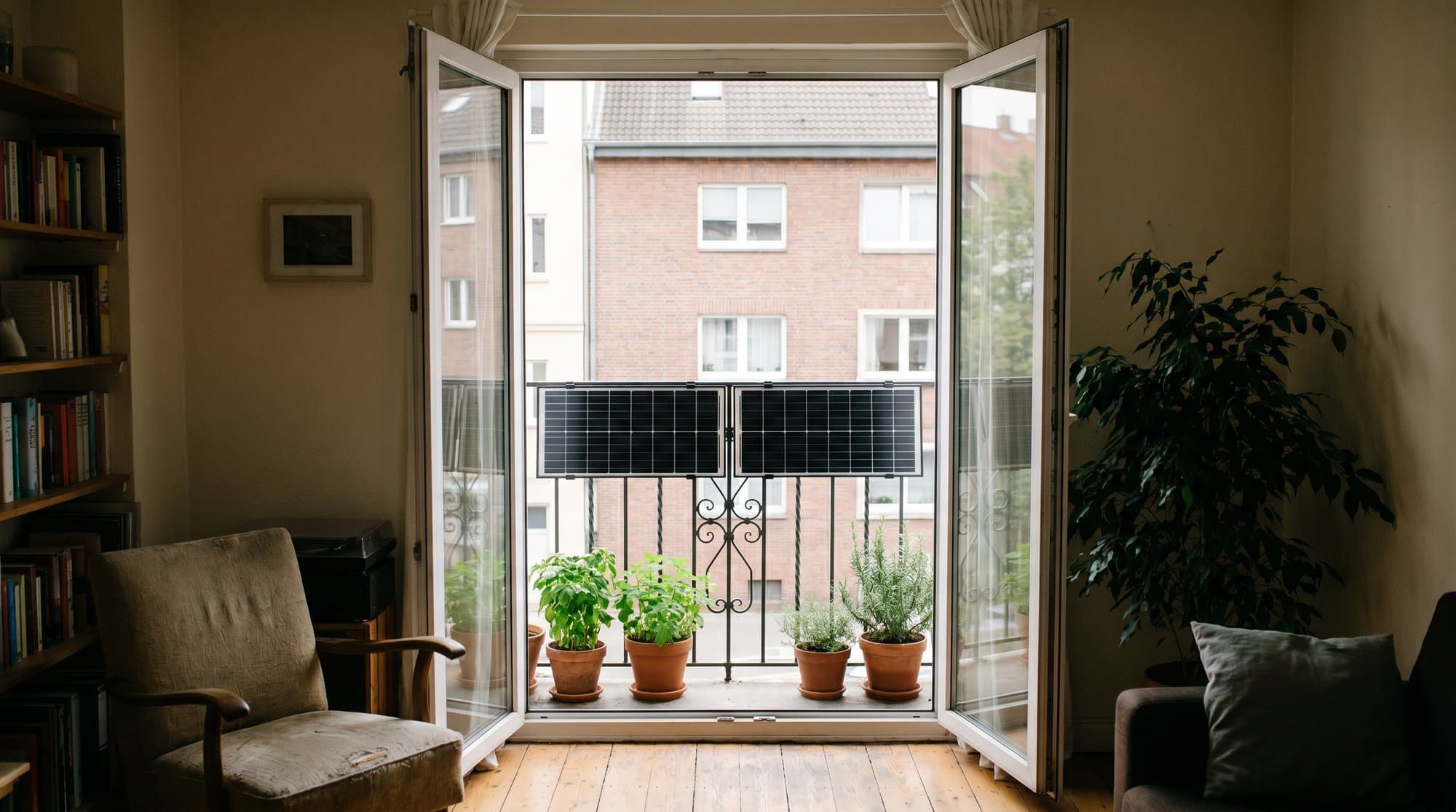
Plug-in solar (also called balcony solar or, in Germany, Steckersolar) is a small photovoltaic system designed for consumer installation. A typical kit is one to three panels and a microinverter that plugs directly into a standard 120V wall outlet. No drilling, no electrician, no roof.
What it generates feeds onto the same circuit your fridge and Wi-Fi run on. Your "always-on" loads soak it up first; the grid covers the rest. The hardware is cord-and-plug, so when a renter moves, they take the panels with them.
The push behind balcony solar legislation is to reclassify these systems as household appliances — like a window AC unit or a toaster oven — rather than miniature power plants. That single legal shift bypasses utility interconnection paperwork, fees, and the "qualified person" licensed-electrician requirement that currently kills most U.S. installations before they start.
Why now
The economics flipped in 2025.
Three things converged: NEM 3.0 gutted rooftop solar payback in California, the federal residential ITC expired on December 31, 2025, and UL 3700 finally gave plug-in solar an American safety standard. Plug-in solar suddenly looks like the most viable residential entry point for new buyers — and the only viable one for renters.
$600–$1,500
Standard kit price
Whole-system, panels + microinverter + mounts.
3–6 yrs
Payback period
At typical U.S. residential electricity rates.
15–25%
Apartment bill reduction
From a typical 800 W kit covering always-on loads.
~50%
of Americans rent
Excluded from rooftop solar today. Plug-in lets them participate.
State of the states
Where it stands, May 2026.
Five states have now enacted plug-in solar legislation. Two more bills sit on governor's desks. Five bills have cleared at least one chamber. Twelve more — including North Carolina — have active bills. Fourteen states have deferred their bills to 2027. Across the five passed laws, a national template is emerging: a 1.2 kW cap, UL 3700 safety standard, no utility approval or fees, mandatory anti-islanding, and a net-metering exclusion.
Enacted (5)
First in the nation. Allows plug-in systems up to 1.2 kW with no utility approval or interconnection fees. UL listing required.
First law to explicitly reference UL 3700. Two-tier: ≤420 W is DIY with no utility notice; 420 W–1.2 kW requires a licensed electrician and 30-day notification. Effective ~July 2026.
1.2 kW cap. No utility approval, no fees, no interconnection. 15-day silent-approval window. Landlords with >4 units cannot prohibit tenant installations. Effective Jan 1, 2027.
Notable for meter-collar provisions: utilities must accept customer-owned meter collars (saves $2K–$5K per install vs. a panel upgrade). UL 3700 required. Effective Jan 1, 2027.
Utility RELIEF Act. Effective immediately via emergency clause. Notification only — no utility approval or fees. 1.2 kW per residential meter; ≤391 W exempt from some UL listing requirements.
On the governor's desk (2)
Plug-in solar tucked into a broader renewable-power package. Passed both chambers in early May 2026. Awaiting Gov. Lamont.
Passed both chambers. Awaiting governor's signature.
Passed at least one chamber (5)
Senate-passed; in Assembly. Exempts portable solar from all interconnection requirements, prohibits utility fees, and includes a utility liability shield. The biggest potential market in the U.S.
Senate-passed; in final House concurrence vote.
Solar Up Now New York. Expanded version of the prior SUNNY Act. One chamber passed.
One chamber passed.
One of three Minnesota plug-in bills. Senate-passed.
Other active bills (9)
States with plug-in solar bills filed but not yet through their first chamber.
Deferred to 2027 (14)
Legislative sessions ended without these advancing. Sponsors expect to re-introduce in 2027.
Honest about hurdles
Why this is hard in the U.S.
European balcony solar runs on Schuko outlets and a code framework that quietly permits cord-and-plug DERs. Bringing the same idea to the U.S. means solving real engineering problems — not just lobbying. Here are the three that actually matter.
Breaker masking
If a plug-in solar kit feeds 10 A into a 20 A circuit while two 14 A hair dryers are running, the breaker only "sees" 18 A and won't trip — but as much as 28 A may be flowing through a section of the wire. Real fire risk.
Bidirectional GFCIs
Standard ground-fault interrupters are designed for one-way power flow. Backfeeding through them can blind or damage the GFCI, leaving the circuit unprotected. Hardware needs to evolve.
Touch safety
European Schuko outlets are recessed. U.S. NEMA 5-15 plugs have exposed prongs during the act of unplugging. Mitigation requires millisecond inverter shutoff or specialized sheathed connectors (Wieland, Betteri).
And on top of the engineering: National Electrical Code Articles 690 and 705 lack provisions for plug-and-receptacle DERs, and Article 406.7(B) is commonly read to prohibit any receptacle requiring an energized plug as its source. Inspectors default to "no" — even when the device itself is safe.
The path forward
UL 3700, registration, and reclassification.
The German model — over a million units installed, no significant safety incidents — works because three pieces are in place: a hardware standard, lightweight registration, and legal classification as an appliance. The U.S. now has the first piece.
UL 3700 (live, early 2026)
America's first plug-in solar safety standard. Mandates automatic power-cutoff in <1 second when unplugged, anti-islanding during outages, and built-in ground-fault detection.
Lightweight registration
No-cost online notification — used by Germany and now adopted by Maryland, Virginia, and the NC HB 1129 framework — gives utilities the visibility they need for grid modeling without the friction of full interconnection.
Appliance classification
Bills like California's SB 868 reclassify plug-in solar as a household appliance, ending the "homeowners-only" club of clean energy. This is the legislative ask.
Advocacy
Three things you can do this week.
Email your state legislator
Reference the Utah HB 340 precedent and California SB 868 as a working model. We've drafted a starter template you can adapt in 30 seconds.
Open the template →Cite the German precedent
One million units, no significant safety incidents. The strongest counterargument to utility safety concerns is the empirical track record — bring it to every conversation.
See the data →Track the legislation
One email per month: which states moved, which bills got named, what's coming up for a vote. No spam.
Get monthly updates →Get monthly updates
One email per month with state-by-state legislative changes. No spam, no list rentals.
Page content draws on two internal briefings: the original "Evolution of Balcony and Plug-In Solar in the United States" (February 2026, covering technology, safety, and economics) and the "May 2026 Update: Five States, One Common Pattern" (current to May 21, 2026, covering the legislative landscape). Bill-by-bill state data is cross-verified against the Bright Saver legislation tracker and primary state-legislature bill-lookup pages. North Carolina HB 1129 details are pulled directly from the bill text at ncleg.gov. UL 3700, NEC, and German installation figures remain from the February briefing.